Showing posts with label harvest. Show all posts

Tuesday, July 19, 2011

Cananga Flowers (Ylang Ylang) Being Sorted and Gathered From the Ground


Cananga flowers (ylang ylang) being sorted and gathered from the ground. The flowers drop to the ground after they are cut from a very tall tree. The harvester, in this case a man, was perilously perched 40 feet above the ground in the branches executing the cut with a hooked blade tied to a 15 foot stick. His wife is on the ground sorting and gathering with amazing speed. Unfortunately they are paid only .45 cents per kilo of flowers.

Photo by Dorene Petersen, ACHS President. © 2011. Bali.

Wednesday, January 5, 2011

Horseradish Named IHA Herb of the Year for 2011


The International Herb Association (IHA) has named horseradish Herb of the Year for 2011!

You may be familiar with horseradish's characteristic pungent aroma and spicy flavor, but did you know that horseradish is high in vitamin C and attributed with antimicrobial properties?

Here are some more horseradish FAQs you may not know:
  • In the United States, an estimated 24 million pounds of horseradish roots are ground and processed annually to produce approximately 6 million gallons of prepared horseradish.
  • Horseradish root is harvested in the spring and fall and the ground horseradish is mixed with distilled vinegar and may also contain salt, sugar, cream, vegetable oil, or ground beets or mustards.
  • The Egyptians knew about horseradish as far back as 1500 BC. and early Greeks used it as a rub for low back pain and as an aphrodisiac.
  • It is said the Oracle at Delphi told Apollo, that "the radish was worth its weight in lead, the beet its weight in silver, and the horseradish its weight in gold."

Learn more about the history of horseradish, its traditional uses, and medicinal properties in the article "Sea-Radish (aka Horseradish)" available for free download in the January edition of the ACHS holistic health newsletter, The Reporter, online HERE.

If you're interested in growing, harvesting, and preparing your own horseradish, this is a very useful video from the City Farmer.

Wednesday, July 7, 2010

U-Pick Lavender at ACHS is Happening Now: Harvest Fresh Lavender!

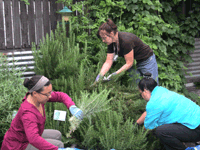
It's that time of year! Our lavender in the ACHS Botanical Teaching Garden is fresh, vibrant, and ready to be harvested. Starting today, stop by the ACHS campus in John's Landing between the hours of 8:30 am-5:30 pm, Monday-Friday, and harvest your own lavender for just $6 per bunch (or 2 bunches for $10).

U-Pick is on until the lavender is gone ... and it goes fast ... so don't wait! Plus, U-Pick is a fun, family-friendly activity. Bring your friends and family for some quality time in the garden!

For a little inspiration, check out the ACHS Aromatherapy Blog, where we have posted directions for making your own lavender wands. Lavender wands are very aromatic and make wonderful air fresheners and sachets, as well as great gifts!

U-Pick Lavender at the ACHS campus, 8:30 am-5:30 pm, Monday-Friday, 5940 SW Hood Ave., Portland. For more information, call (503) 244-0726 or email achs@achs.edu.

Friday, July 10, 2009

ACHS lavender distillation yields 30 mls of essential oil

On June 30 ACHS held a public distillation of lavender from the botanical teaching garden. About a dozen community members helped College President Dorene Petersen with the distillation, including harvesting the lavender from the garden.

Historically, lavender Lavandula angustifolia has been used to relieve stress and its effects, including insomnia and anxiety, and to generally aid relaxation. It can also be used around the home as an effective deodorizer and air freshener, in closets and drawers as a natural insecticide, and as a perfume.

Lavender oil is colorless, pale-yellow or yellowish-green oil. It must be stored at cool temperatures in well-filled, airtight containers, and protected from light.

>>To sample the lavender essential oil from the ACHS distillation, check out the Apothecary Shoppe College Store for your free sample.

>>To see more pictures from the ACHS lavender distillation, friend us on Facebook.

>>To watch the ACHS lavender harvest and distillation, visit our Youtube channel, ACHStv.

Monday, July 6, 2009

Lavender lovers, pick your own at ACHS from July 6-17


The ACHS botanical garden is brimming with fresh lavender. Starting July 6, stop by the campus to pick your own fresh lavender, tour the garden, and learn a bit about the health properties and applications of lavender.

Lavender U-Pick runs July 6-17, Monday-Friday, 8:30 am-5:30 pm. But if you can't participate during business hours, ACHS also offers the Honor Code U-Pick. Participants are welcome to harvest their lavender after hours or on the weekend, but are asked to pay for their bunches via PayPal. Send payment to apothecary@achs.edu.

ACHS is located at 5940 SW Hood Ave. in John's Landing. For questions, call (503) 244-0726, visit www.achs.edu, or email achs@achs.edu.

To read more about the history of the ACHS Lavender U-Pick, check out this article by The Oregonian.

Thursday, June 18, 2009

Rosemary distillation at ACHS a great success

ACHS President Dorene Petersen led a rosemary distillation on the American College campus Wednesday, June 17. From the ACHS Botanical Teaching Garden, Dorene and ACHS student participants harvested about 10 lbs. of fresh rosemary.

The distillation was a terrific success and led to a great yield. From the 10 lbs. of rosemary Rosmarinus officinalis, which was stripped from its woody stems to ensure the highest quantity of anti-inflammatory ester borneol acetate, nearly 45 mls of essential oil was extracted, and nearly 1,000 mls of hydrosol.

As a thank you to the attendees who volunteered their time to help with the harvest and distillation, everyone took home a vial of rosemary essential oil and some hydrosol.

Hydrosols, also known as flower water, are steam distilled from plant material. Hydrosol is similar to essential oil, but less concentrated. They are often used externally in skin care, and work well as a simple mist.

For more information about harvesting rosemary for distillation, check out ACHS on YouTube. A video of President Dorene Petersen explaining the process of harvesting and distillation of essential oil will be available for download on ACHStv soon.

To participate in a future ACHS distillation, check out the College community wellness classes calendar. On July 17 ACHS is hosting a U-Pick Lavender Open House on the ACHS campus. Then, on July 18, ACHS Senior Vice President Erika Yigzaw will lead a lavender distillation at Sherwood Lavender Farms.

Friday, April 3, 2009

Trilliums in Tryon Creek State Park: A Sunday Hike In The Rain

This is one of the main trails in Tryon Creek State Park. You can’t tell from the photo, but at the moment it was taken, freezing rain was falling. Moments after setting foot on the trail, I spot the first trillium.

Trillium is an easy plant to identify. It has a single succulent stalk and three leaves. In spring it bears a large white three petaled flower which turns slightly pink as it matures. Finding the flower is not so important to an herbalist, who will appreciate the blooms is spring, but seeks to harvest leaves, stems and roots in the fall. Trillium can be found in moist old-growth of the Pacific Northwest from the Redwoods of California, the coast of B.C., either side of the Cascade Range in Oregon and Washington, the northern part of Idaho and the mountains of Alberta, Montana and Wyoming. According to Michael Moore in Medicinal Plants of the Pacific West, “Find a creek starting in the forest, follow it down through the trees to where it begins to broaden out, and you will usually find some trillium.

Trillium, often referred to as birth root, is a member of the Liliaceae family. It is a mild remedy with minimal chronic toxicity. It has historically been used to astringe uterine bleeding, and has been used in treating fibroids. It has many uses according to Peter Holmes. It resolves mucus, damp and congestion and stops discharges and bleeding. It can harmonize menstruation and menopause (it increases progesterone), it can stimulate the uterus to promote labor and delivery. As a ‘cough root’ it is used as an expectorant to resolve thick phlegm in a difficult and dry cough. The fresh root (rhizome, actually) is best to use in a decoction or tincture. Washes and compresses can be used for sores and inflammation. Roots well worth learning about if you live in the Northwest.

What else did I see?

In the same area, I also found coltsfoot, cleavers, salal, Oregon grape, and usnea. No doubt there is much more I did not notice. After all, I was only looking for trillium flowers.

About the Author
Scott Stuart, L.A.c., teaches herbal medicine for the Australasian College of Health Sciences, and practices Oriental Medicine at Outside/In, a Portland, Oregon, social service agency.

ShareThis